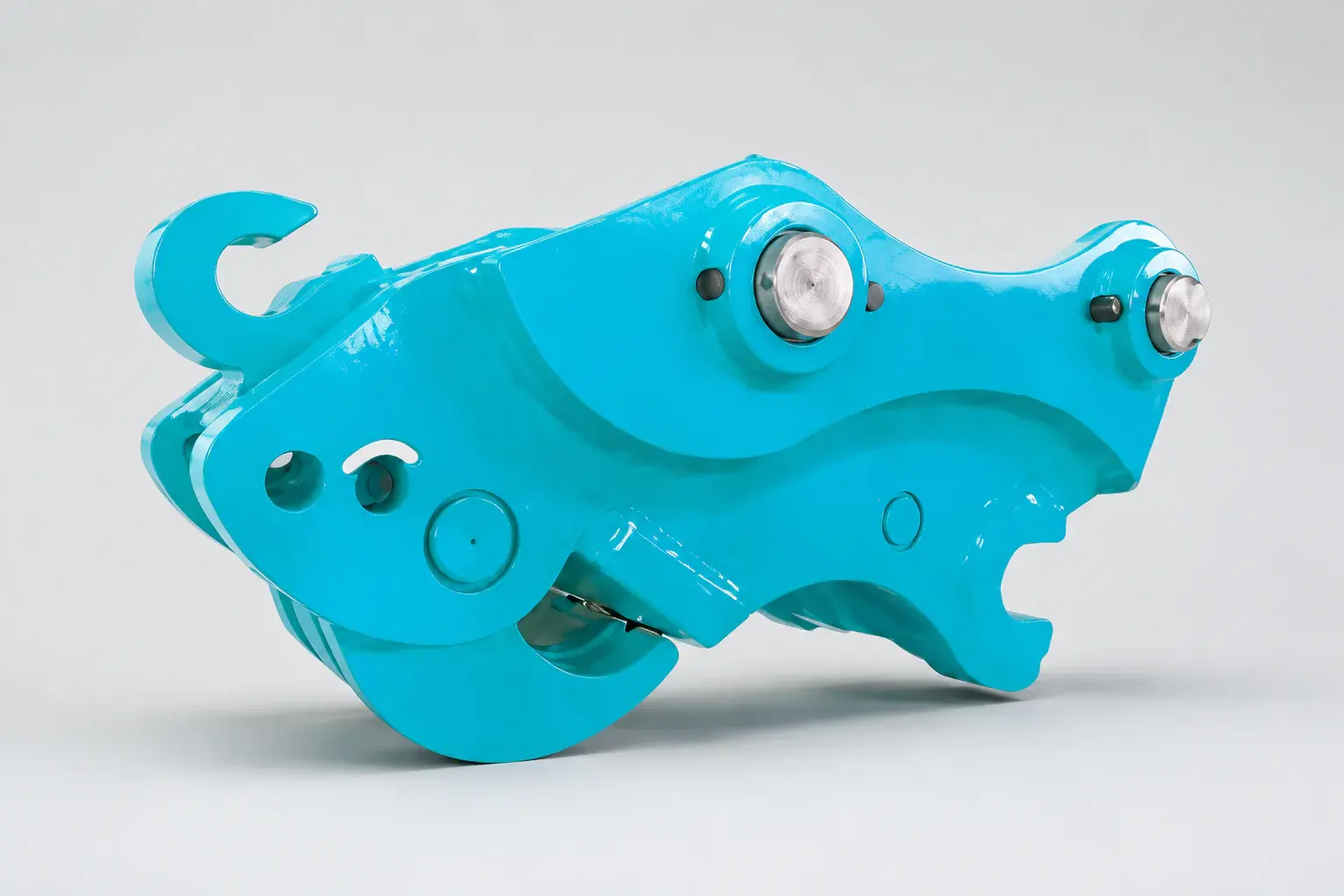
A quick coupler reduces attachment-change time, but it is not a universal adapter. The coupler must match the carrier, every intended attachment, the hydraulic installation and the applicable operating and safety requirements.
CONCEPT COMPARISON
| Concept | What changes | What to verify |
|---|---|---|
| Manual mechanical | The operator actuates the locking mechanism at the coupler. | Locking procedure, retention system and inspection access |
| Hydraulic | The carrier hydraulic circuit actuates the locking mechanism. | Pressure, valves, controls, indication and test procedure |
| Tilt or rotating | The coupler system also changes attachment angle or orientation. | Working envelope, added mass, hydraulics and attachment clearance |
| Fully connected | Compatible hydraulic services connect with the attachment interface. | Interface standard, services, cleanliness, controls and attachment compatibility |
Build an attachment compatibility list
List every bucket or tool you intend to use, with its pickup type, pin dimensions where applicable and any hydraulic services. Ask the supplier to identify which combinations are covered by the proposed coupler and which require a different interface.
Agree the model-specific installation instructions, retention checks, operator training and commissioning responsibility before purchase. A successful connection with one bucket does not approve all attachments in the fleet.
- Carrier and coupler model or proposed drawing revision
- One line per attachment, including mass and pickup details
- Hydraulic connections and control requirements for powered tools
Understand the main coupler concepts
Manual couplers require direct mechanical operation. Hydraulic couplers use the carrier circuit to operate the locking mechanism. Fully connected systems may also connect hydraulic services, but require a compatible attachment interface.
- Manual mechanical coupler
- Hydraulic pin-grab or dedicated pickup
- Tilt or rotating coupler system
- Fully connected hydraulic interface
Measure both sides of the interface
Record the carrier pickup geometry and the pins or dedicated interface on every attachment. Do not assume that attachments for the same machine class share one pickup.
- Front and rear pin diameters
- Pin center distance
- Dipper width
- Attachment pickup and coupler brand
Confirm hydraulics and controls
Hydraulic models require confirmed pressure, hose routing, valve behavior and operator controls. Installation and testing should follow the coupler instructions and the rules applicable where the machine will operate.
- Working and relief pressure
- Valve and check-valve arrangement
- Hose routing and protection
- Operator indication and test procedure
Prepare a model-specific approval
The published PINSHENG quick-coupler range covers 5–65 tonne excavators and 45–120 mm pins. A final interface drawing should be reviewed before manufacturing.
- Carrier serial and model details
- List of intended attachments
- Approved critical dimensions
- Installation and commissioning responsibility
COMMON BUYER QUESTIONS
What are the main excavator quick coupler types?
Common concepts include manual mechanical couplers, hydraulically operated couplers, tilt or rotating coupler systems and fully connected systems that also connect hydraulic services.
Are excavator quick couplers universal?
No. Pin geometry, dedicated pickup systems, attachment dimensions, hydraulics and regional safety requirements differ. Every carrier and intended attachment must be checked.
What measurements are required for a quick coupler quote?
Provide both pin diameters, pin centers, dipper width, carrier make and model, operating weight, hydraulic details and the pickup dimensions of every intended attachment.
OFFICIAL SAFETY REFERENCES
- OSHA: Hazards of inadequately securing hydraulic excavator buckets ↗
- UK HSE: Industry guidance on quick hitches ↗
- Safe Work Australia: Quick-hitches for earthmoving machinery ↗
Requirements vary by jurisdiction, carrier and coupler system. Always apply the current local rules and the manufacturer instructions for the exact equipment.